

What is decarboxylation?
Decarboxylation sounds like a complicated lab procedure, but the truth is that you’re probably a master decarboxylator already. If you’ve ever heated marijuana at all, you’ve already decarbed it. Consider yourself a total newbie? No worries! If you’ve ever successfully cooked something in the oven or microwave, high five, you’re ready for decarboxylating cannabis. Basically, decarboxylation is the process of heating up marijuana to a specific temperature to activate the compounds in it.
When to decarb marijuana
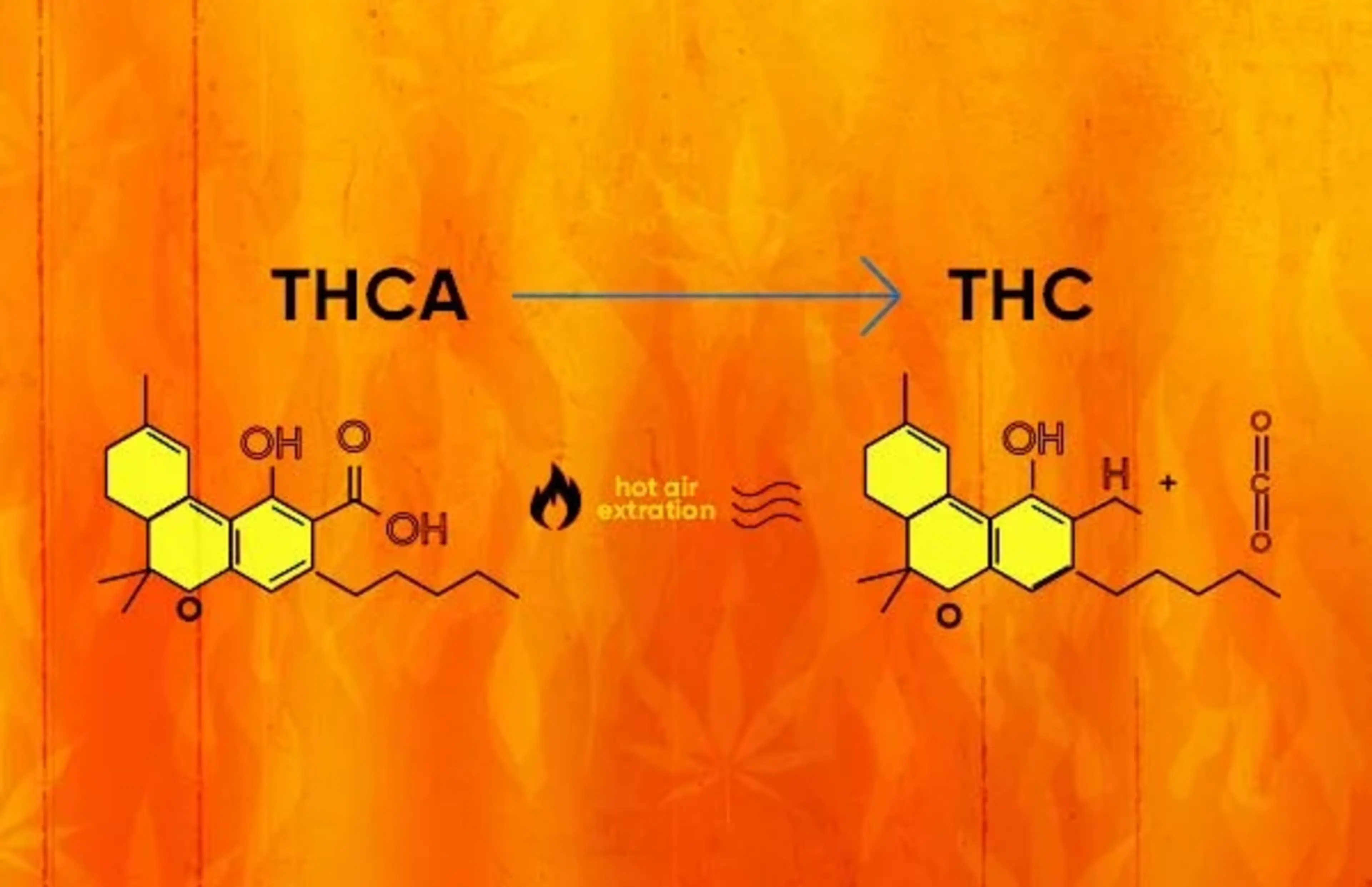
Simply put, you need to decarboxylate marijuana if you want to feel the potentially euphoric effects of THC or if you want the benefits of CBD. Raw cannabis plant doesn’t contain much CBD or THC just yet, these compounds are synthesized in marijuana from CBDA (cannabidiolic acid) and THCA (tetrahydrocannabinolic acid) respectively through the decarbing process. [Source]
Decarbing can be as simple as touching a flame to the flower. But igniting cannabis can lead to partial loss of many of the compounds that make cannabis use enjoyable and beneficial for many. [Source]
Additionally, if you want to make edibles that aren’t going to be baked or cooked before eating, you’ll need to decarb it—otherwise, you will just have marijuana-flavored food.
Advantages of Decarbing Cannabis
Cannabis chefs will tell you that a major advantage of decarboxylation is that it allows you to make any food into an edible. If you’ve ever wanted to make tinctures or turn your favorite non-baked goods into THC-infused ambrosia, then decarbed cannabis is what you’re looking for.
How Does Decarbing Work?
As we’ve explained, THCA and CBDA in raw cannabis are not the same THC or CBD that many of you are familiar with. Looking closely at a raw cannabis bud, you’ll notice lots of gooey, crystalline droplets covering it. These are the trichomes—glands where marijuana compounds like cannabinoids, terpenes and flavonoids are produced. Here you can find the cannabis acids mentioned above: THCA and CBDA. By exposing cannabis to heat, it ejects the “A”—an organic molecule called a carboxyl group—and leaves the THC and CBD that we know (and many of us happen to love). [Source]

Cannabis decarboxlation temperature
A classic misstep of novice cooks the world over: assuming higher heat creates faster results. This is especially important when it comes to decarbing in the kitchen.
In general, all the compounds in marijuana decarb at about 240ºF, but it is not instantaneous. Part of the reason decarbing takes anywhere from 30 minutes to an hour is that there is no set threshold when all the THC or cannabinoids cross over from acid to “activated.” Like microwaving a bag of popcorn, there will be a less than 100% pop rate. You need to give the cannabis time and, unless you are an expert on the strains you’re using and a maestro at manipulating your oven, there is some loss of compounds to be expected, either to burning or to inactivation.
Cannabinoids
The big two, THC and CBD, are probably the best-known cannabis compounds. Something to be aware of is their relatively low boiling points (315ºF and 320ºF for THC and CBD, respectively) compared to their decarbing temperature.[Source]
Terpenes
Terpenes are what give cannabis strains their unique aromas and flavors and are as chemically variable as they are culinarily diverse. Some cannabis terpenes boil at temperatures much higher than cannabinoids, but others boil off mere degrees above the recommended decarbing temperature of 200ºF – 290ºF (95-145ºC). Destroying these compounds won’t get you any less high, but it may result in an acrid flavor that makes consuming your edibles into more of a chore than a delight.[Source]
Flavonoids and Phytosterols
Both flavonoids and phytosterols are common compounds found in all plants, and cannabis contains a variety that is common to all plant life yet unique to itself. Though prohibition has made cataloging the flavonoids and phytosterols in cannabis difficult, those that are known have a higher boiling point than cannabinoids.[Source]

Chemistry of decarboxylation: THC and CBD
If you’re comparing sativa-dominant strains vs indica-dominant ones, the good news is there are no adjustments to be made as you are mostly focused on THC production. The difference between decarbing for THC and CBD, however, is a bit more subtle.
What’s the difference between CBD and THC when decarbing?
For the most part, there is little difference between decarbing with THC or CBD in mind, though CBD carboxylation may benefit from slightly lower temperatures, closer to 230ºF (110ºC).
What happens if you are decarbing a THC/CBD balanced strain?
If you’re decarbing a 1:1 strain, you will generally not have to adjust anything, but there is a decent chance that the ratio will favor one or the other depending on your process. A lower, longer bake will most likely favor a higher CBD ratio, while the recommended 240ºF (116ºC) for a 30-minute bake may cook off some CBD, thus favoring THC quantity.
Is decarboxylation necessary for edibles?
Decarboxylation is necessary to activate the THC and marijuana cannabinoids, so any edibles that aren’t cooked need to be infused with decarboxylated cannabis.
If you’re baking, it’s best to make cannabutter or canna-oil to use in the recipe.
Can you make cannabutter without decarbing?
Cannabutter and canna-oil can be made without decarbing, but the butter will be no more psychotropic than the sticks you get at the grocery store. That’s because the fats will pull the THC and CBD in their inactive acid states: THCA and CBDA. By decarboxylating cannabis first, the THC and CBD will be “activated,” and the butter can be applied to any food—hot or cold—and deliver the psychoactive effects.
Also, worth noting—improperly decarbed butter and oil are susceptible to harmful pathogens. So, nutritionally speaking, it’s definitely best to decarb before making cannabutter.
How to Decarboxylate Cannabis
By now you know the importance of decarboxylation in any mode of cannabis consumption, but which method is the most efficient? Smoking marijuana requires high temperatures to combust the flower, but decarboxylation itself doesn’t require nearly so much heat. The key to decarbing when cooking is just like using a Crock-Pot: low and slow. And remember, you want your cannabis lightly browned, not dark brown.
There are many ways to decarb at home, ranging from easy enough to unbelievably easy—it’s all a matter of how much THC loss matters to you and how much time you want to devote to the process.
Natural Method
Entropy affects cured marijuana—given time, cannabis will actually decarb itself, but this process takes an exceptionally long timeframe and provides no quality control. In other words, there’s no telling just how much of your THCA has been converted to THC. Unless you’ve got flowers and time to spare, and we’re talking over a year, this method is probably not ideal. (Hey, it would make a pretty cool long-term science experiment, though.)
Baking Sheet
By far the simplest and most common way to decarb marijuana is to bake it in an oven: Place a baking sheet-covered pan in the middle level of your oven
Grind up your flower and spread it over a parchment-lined baking sheet
Set your oven to 220- and 240-degrees Fahrenheit (105-115 C) and bake for 30 minutes
You’ll notice that your cannabis has slightly changed its color to a more golden hue
Don’t let it overheat and get too brown, this will make it lose its potency
Oven Bag
Nearly identical to the baking sheet method:
Place a baking sheet-covered pan in the middle level of your oven
Put your ground-up cannabis in an oven bag and tie it up
Place it on the baking sheet
Same temperature and time
Let it cool for a bit and store for future use
You can also throw an oven bag into a pot of water and boil for 90 minutes. Though it is more time-intensive, the major benefit to boiling is that the cannabis will not burn.
Mason Jar
Using a mason jar to decarb is great if you want to control odors:
Set your oven between 220- and 240-degrees Fahrenheit
Place the oven rack in the middle position
Cover a baking tray with a sheet of baking paper with a lightly wet kitchen towel on top of it
Put the ground cannabis flower in the jar
Lightly screw on the lid (just don’t make it too tight, as this can cause the jar to burst)
Place your jar on top of the towel
Bake for approximately 60 minutes
Carefully remove the jar from the oven and give it a shake every 15-20 minutes to make sure the cannabis is dispersed evenly
When done let cool for 20-30 minutes
WARNING: The glass will be VERY HOT!!!
Microwave Oven
For those without a lot of time to spare or who would like to scale test decarbing, using a microwave is a quick—albeit more hands-on—method.
Grind the cannabis and put it in a microwave-safe bowl
Cook on high for 90 seconds
It should smell pungent but not burned. If you’re not getting either, run it for another minute and repeat as needed.
Stay close, because if you smell burning you’ll need to stop the microwave immediately
If you’re concerned about burning, you can also try a lower setting. (Just stand by and keep an eye on the microwave!)

Decarb Machine
We just might be living in a golden age of cannabis consumption. Not only are there varied and powerful strains—we also have plethora of innovative tools to get the most out of them. So maybe it shouldn’t come as a surprise that a dedicated decarboxylating machine exists. It consumes less energy than an oven and contains odors better than any other method (except maybe the good old mason jar). Plus, they even have sensors that turn off the heat as soon as they sense that the cannabis has reached its ideal temperature. If you foresee a lot of decarbing in your future, a decarbing machine may be worth the investment.
Have more questions? The staff at your local RISE Dispensary loves to talk decarboxylation!
Step-by-Step Decarboxylation Guide
Oven
Preheat oven to 240°F(116ºC)
Grind cannabis
Place your ground cannabis in the desired receptacle:
Baking Sheet — line sheet with parchment or foil and place on oven rack
Oven Bag — tie a tight knot, place on a baking sheet (no liner needed), and place on oven rack. Leave some room in the bag for air to expand.
Mason Jar — leave the lid loosely on and place directly on oven rack
Bake for 30 minutes or until browned (if using a mason jar, let cool before opening)
Microwave
Grind cannabis
Place it in a microwave-safe bowl or tray
Microwave on high for 90 seconds (or lower temperature setting depending on power output)
Remove bowl and smell. If not pungent, stir and return to the microwave for another 60–90 seconds, standing by to stop the microwave if burning.
Repeat Step 4 as needed
Stovetop
Boil a large pot of water
Grind cannabis
Place cannabis in an oven bag and tie in a tight knot
Place bag in boiling water for 90 minutes
Remove and let cool


